Throwback Thursdays” at ClimbingSky feature posts I wrote over a 15 year period for various blogs. This was first posted on June 23, 2020.

Last week after finishing In Dubious Battle, I continued my Steinbeck-binge by getting The Wayward Bus. Like Cannery Row and In Dubious Battle, this was another book I had first read 45 years ago in Townsend, Montana.
Originally published in 1947, The Wayward Bus was Steinbeck’s first novel published after the incredibly successful The Grapes of Wrath. In theme and style though it share more in common with In Dubious Battle. Of the three Steinbeck books I have recently re-read and reviewed here, it is my least favorite, though I still enjoyed it. But not as much as I remember having done so all those years ago.
The Wayward Bus is not plot-driven but rather character-driven. It focuses on the lives of various individuals who converge at Rebel Corners, a desolate crossroads in California. The narrative shifts perspectives frequently, offering insights into the inner thoughts and motivations of each character.
The story centers around Juan Chicoy, a bus driver who owns a small lunch counter with his unhappy wife, Alice. A diverse cast of characters pass through Rebel Corners, including a disillusioned salesman, a seductive stripper, a self-important businessman, and a young waitress obsessed with Clark Gable. The novel explores themes of isolation, dissatisfaction, and the search for meaning in the face of mundane routines and societal pressures.
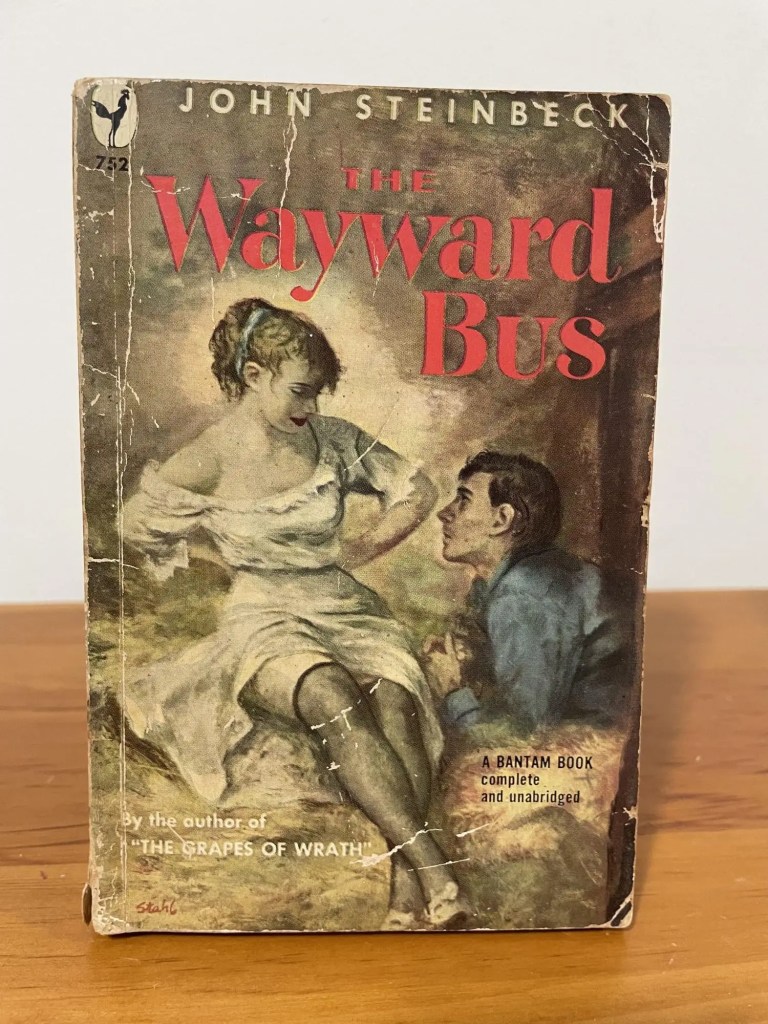
As I have been writing about these Steinbeck books here, I have also been posting various corresponding book covers. One of the things I have noticed as a paperback book junkie is that paperback covers of serious novels published in 1950s-1960s often feature painted covers that highlight sexuality and sexual tension of some kind (even if there is none at all) to “entice” unwitting buyers into purchasing the books and giving it a go.
In the case of The Wayward Bus, such a cover is entirely appropriate and consistent with the plot and themes. But in the case of In Dubious Battle (and to a lesser extent, Cannery Row) that kind of cover is at best misleading. It would probably make an interesting collection to find and display the most “sexualized” paperback covers of Nobel Prize winning authors and prize winning novels.
 ClimbingSky
Leave a comment