Throwback Thursdays” at ClimbingSky feature posts I wrote over a 15 year period for various blogs. This was first posted on October 26, 2013.
… there is no more consistently perfect body of recorded work in jazz than that produced by Lester Young between 1936 and 1941 – with Count Basie’s orchestra, with Billie Holiday and with various small groups such as the Kansas City Seven. (From Dave Gelly’s introduction to Being Prez)
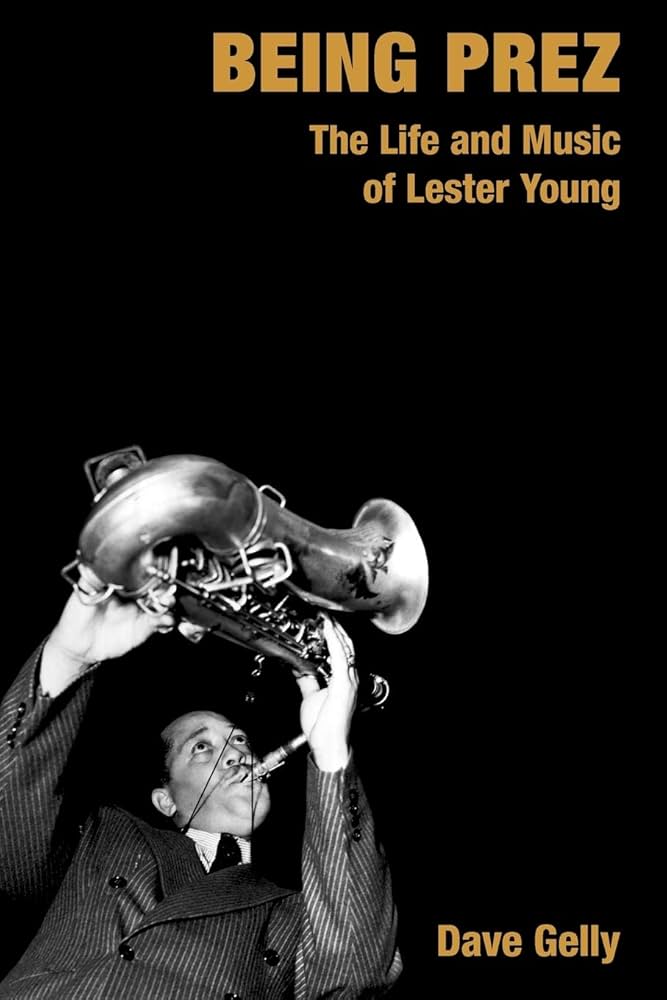
In addition to listening to a lot of Jazz of late, I have also been reading a number of books about Jazz including Dave Gelly’s excellent book Being Prez: The Life and Music of Lester Young.
Being a non-muscian, I have found over the years that people who write about music are not always able to communicate to those of us who cannot even read music. This has been particularly true with books about Jazz. Instead of making the music more accessible, they merely make it more intimidating.
Gelly is both a jazz critic and a saxophonist, yet he is also a pretty good writer. Not a great writer, but good enough. It is his subject, saxophone legend Lester Young and Young’s incredible music, though who are the star of the book.
Gelly knows Lester Young’s music, and clearly loves it. And it is this love of Prez’s music and Gelly’s understanding of Young’s impact on other jazz musicians that makes this worth reading.
What should a good biography of an artist do?
- Deepen your appreciation of the artist’s work
- Inform you about artistic influences and relationships
- Take you deeper into an artist’s work
- Entertain you along the way
Gelly accomplishes all of these in Being Prez.
Here are some quotes:
Lester Young on How he started playing first the Alto and then the Tenor Sax
“All the other guys got their clarinet cases, trombone cases, trumpet cases and here I am, wiggling around with all this shit!… Carryin’ all them drums got to be a real grind. I decided I’d better get me a lighter instrument.”“We’d all be ready. We’d be waiting for ninety years to get us to work, you know. And he said: ‘Wait for me until I get my shirt on, and get my tie on’, and all that shit, and everybody’ll be waiting, disgusted. So I told the boss man – his name was Art Bronson – I said: ‘Listen, why should we go through all this shit?’ I said, ‘You buy me a tenor saxophone and I’ll play the motherfucker and we’ll be straight then.’ And he went to the music store, got me a tenor sax and we split. As soon as I got my mouth round it, I knew it was for me. That alto was a little high for me.”
* * * * * * * * * *
Lester Young on musical influences
“Frankie Trumbauer and Jimmy Dorsey were battling for honours in those days, and I finally found out that I liked Frankie Trumbauer. Trumbauer was my idol. When I started to play I used to buy all his records. I imagine I can still play all those solos off the record. He played the c-melody saxophone. I tried to get the sound of a c-melody on a tenor. That’s why I don’t sound like other people. Trumbauer always told a little story, and I liked the way he slurred his notes. He’d play the melody first and then after that he’d play around the melody.” [Trumbauer], that was my man… Did you ever hear him play ‘Singing The Blues’? That tricked me right there. That’s where I went.”
* * * * * * * * * *
Lester Young on the first time he sat in for Coleman Hawkinghs
‘I’d always heard so much about [Coleman Hawkins] ,’ Lester recalled. ‘I ran over to dig him between sets. I hadn’t any loot so I stayed outside listening… Herschel was out there, too.”” But Hawkins had failed to show up. “I ran a million miles to hear Coleman Hawkins play and he wasn’t there. So Fletcher Henderson ran out saying, “Don’t you have no tenor players here in Kansas City? Can any of you play?”… Herschel was out there, you dig, but he couldn’t read. So they say, “Red!” (they called me Red then) “Red, go and blow this goddam saxophone!” And I’m coming to see Coleman Hawkins, they told me how great he was!… So they showed me in and I get up and grabbed his saxophone and played the motherfucker and read the music and read his clarinet parts and everything. Now I got to run back to myjob where there’s thirteen people in it. Run ten blocks to get to ‘em!”
* * * * * * * * * *
Gelly on Billie Holiday’s and Lester Young’s Relationship
Everyone who knew them at the time, and has spoken about the matter subsequently, agrees on one thing: the relationship was entirely platonic. Billie went for dominant, masterful men, which Lester certainly wasn’t. As we have seen, he was shy and unassertive, whereas she was street-wise, quick-tempered and open-hearted. By all accounts, she treated him rather like a younger brother, although he was six years her senior.
* * * * * * * * * *
Gelly quoting John Hammond on Lester Young’s Improvisation Ability
He would launch himself headlong into improvisations which, with each new chorus, renewed themselves as if by magic; it was as though his energy and originality knew no bounds. Lester could improvise on the same theme for an hour at a stretch, without once giving the impression that he might be running out of ideas… His features evinced not the slightest emotion and his whole being was concentrated in the music.”
* * * * * * * * * *
Gelly on Jazz Recordings
Jazz music is unique in one important respect, namely that it was the first performed music to be widely recorded, and therefore not only preserved in time but heard beyond the culture which created it. Because of recording, the whole world can today listen to Lester Young playing with the Count Basie orchestra in 1938. This means that jazz recordings became definitive ‘texts’, and nowadays assume a position of prime importance to both performers and listeners. But this was not necessarily the case back in 1938.
* * * * * * * * * *
Gelly on the recording of “Taxi War Dance”
Lester’s main solo comes at the very beginning. Opening with a twisted quotation from ’01′ Man River’, hejumps in as though propelled by powerful elastic. The harmonic sequence is, in effect, a truncated version of the ballad ‘Willow Weep For Me’. The way he flips lightly through the chord changes, touching each one deftly while carving an elegant and energetic line, puts one in mind of a gymnast or ballet dancer. He arrives at the final cadence at the last possible moment, landing with a negligent little bounce. No one else could have done it because no one else’s mind worked that way. The thought and its expression are one and instantaneous, and that is what makes jazz unique in Western music.
* * * * * * * * * *
Gelly on the Saxophone and the Human Voice
…the saxophone, of all instruments, most resembles the human voice. Our voices convey far more than words. They betray our feelings, our age, our confidence or lack of it, even our state of health. They are us, physically and spiritually, and the uncanny parallel between voice and instrument extends to this as well.
* * * * * * * * * *
Gelly on Lester Young’s Army Experience
One of the most telling phrases in Lester’s private language was ‘I feel a draft’, meaning that he detected racial hostility. He had always been sensitive to such drafts and now this sensitivity expanded to obsessive proportions. To express it, he coined a new phrase of almost Jacobean resonance: ‘Von Hangman is here’.
* * * * * * * * * *
Lester Young on Jazz Concerts
In fact, Lester often said that he preferred playing for dancers, where there was a clear if unspoken relationship between them and the musicians. He certainly arrived at a fairly jaundiced view of concert audiences. ‘The people look up and they don’t know if you’re playing good or bad’, he said once. ‘Sometimes you’ll put on an act and they’ll clap when you’re playing bad.”
* * * * * * * * * *
Bobby Scott on Lester Young
”He was a night person…He entered the evening. Even the quantity of his words increased as the light of day waned. It was as if he’d climbed a ridge of small hillocks, then settled into a golden period, a span of bewitched time… His stick-like body, so worn by his utter disregard for its health, straightened to its limit only during those hours of music. And the music turned on his capacity of camaraderie and humor.”
* * * * * * * * * *
Gelly on Lester Young’s influence on the Beat Generation
There were people who wanted to be just like that – cool, detached, undemonstratively eloquent. It comes as no surprise to find, a few years later, the name of Lester Young among the founding deities of the Beat Generation. Allen Ginsberg claimed that his archetypal Beat poem, ‘Howl’, was inspired by ‘Lester Leaps In”
* * * * * * * * * *
Gelly on Lester Young’s influence on Miles Davis
Miles claims that he learned from Lester the ‘running style of playing’ which has a ‘softness in the approach and concept and places emphasis on one note’.4 He contrasts this with the bebop of Parker and Gillespie, whose approach was more rather than less’, and who used ‘a lot of real fast notes and chord changes’. He on the other hand was seeking the opposite, ‘a kind of stretched-out sound’. Lester’s reluctance to chase after complex, chromatic chord patterns, but instead to find a way through them which emphasized melodic line, has already been noted. His recordings with John Lewis in particular owe much of their charm to this very tendency.
* * * * * * * * * *
Gelly on Lester Young’s music
The beauty of Lester Young’s music endures. Even in its worst moments, when mere execution seems a near-insuperable problem, its very fragility conveys a unique essence. If there is a word to describe it, that word is ‘truth’.


Leave a Reply